Sample Grant Proposal: Returning Storytellers
Cover Letter
Adrian English
2126 Burns View Lane
Lawrenceville, GA 30044
adriantheeprofessor@gmail.com
(240) 565-5523
November 21st, 2024
Tori Hannah
Grant Coordinator
Georgia Power Foundation
241 Ralph McGill Blvd NE
Atlanta, GA 30308-3374
Dear Ms. Hannah,
I am excited to submit this proposal for funding the Returning Storytellers Program, a transformative initiative designed to empower returning citizens—individuals recently released from incarceration—by equipping them with the storytelling skills needed to rebuild their lives and contribute positively to their communities.
The challenges faced by returning citizens are immense, with barriers such as mental health struggles, employment difficulties, and societal stigma often leading to cycles of recidivism. In Georgia alone, over 600,000 individuals are released from incarceration annually, yet the state faces a 26% recidivism rate, highlighting a critical need for innovative, evidence-based solutions. Returning Storytellers addresses this gap by teaching twenty participants how to process their experiences, take control of their narratives, and build essential communication and emotional resilience skills.
This program’s unique approach integrates storytelling techniques with practical support, fostering personal growth and improving participants’ chances of successful reintegration. Through workshops, journaling exercises, public speaking opportunities, and mentorship, participants will gain the tools necessary to navigate societal challenges, form stronger family and community bonds, and establish a foundation for future success.
As the program’s founder, I bring both professional expertise and lived experience to this initiative. I am a professional writer, published novelist, and honor student at Grand Canyon University, majoring in Professional Writing for New Media. More importantly, as a returning citizen myself, I understand firsthand the challenges of reintegration and the transformative power of storytelling in shaping one’s path forward.
The funding requested will support curriculum development, workshop facilitation, and community engagement efforts, enabling us to launch this vital program and track its measurable outcomes. With your support, we aim to reduce recidivism, strengthen families, and foster safer, more inclusive communities.
Thank you for considering this proposal. I would welcome the opportunity to discuss how the Returning Storytellers Program aligns with your organization’s goals and how your investment could create lasting change for individuals and communities in Georgia. Please feel free to contact me directly at adriantheeprofessor@gmail.com or (240) 565-5523.
Sincerely,
Adrian English
Founder, Returning Storytellers Program
Returning Storytellers,
A New Solution for An Old Problem
Submitted to the Georgia Power Foundation
November 24th, 2024
Adrian English
2126 Burns View Lane
Lawrenceville, GA 30044
adriantheeprofessor@gmail.com
(240) 565-5523
Project Abstract
Returning Storytellers empowers formerly incarcerated individuals by teaching them storytelling skills to encourage personal growth, communication, and help them in transitioning back to the community. Over the course of 24 workshops, twenty returning citizens will learn how to craft and share their stories and build confidence and skills that are critical for improved communication. The program will arrange for transportation for those who need help attending and provide materials that will eliminate barriers to participation. The endgame is an Open House/Open Mic night that will promote understanding and connection. By using a robust evaluation plan, the program will track progress in communication skills, self-efficiency, and community engagement in a way that can be measured. This program endeavors to transform lives by amplifying the voices of those who are often marginalized and create within them a spirit of resilience to reduce recidivism through creative expression.
Statement of Need
In this country, there seems to be a major focus on the number of people going into prison, but not as much focus on the people coming out until they become statistics for having failed at successfully re-entering society. In Georgia each year, almost 500,000 men and almost 130, 000 women are released from incarceration (Prison Policy Initiative, n.d.). Many of them do not have the resources needed to become productive citizens once they touch down on the streets. While there are organizations that may provide resources in the way of clothing, vocational training, and housing assistance, often, because of the sheer number of “returning citizens”, resources can quickly become strained. However, there is one area in which many returning citizens have a need and very few organizations meet that need. This is something Greater Gwinnett Reentry Alliance (GGRA) seeks to address. That resource is the mind of the returning citizen.
One of the things many who were incarcerated deal with is mental turmoil. Being locked up can be traumatic for many, regardless of circumstances. They have dealt with losing their identity, almost constant dehumanizing situations, and the loss of family and relationships. When they’re released, they’re expected to find work, a home, and transportation. However, many of them still have the mental turmoil to deal with as well as the new mental challenges created by their new circumstances.
What GGRA proposes is the creation of a writing and storytelling workshop for people leaving incarceration and returning to society. Post-release programming for the formerly incarcerated reduces the recidivism rate by 11% (Russ et. Al., 2021). This is meaningful because the lower the recidivism rate, the lower the strain on society, from a financial standpoint and the standpoint of safety.
This program will teach former inmates how to tell their stories. It will show them how to process their inner turmoil and to use that for fuel. They can then take these stories and share them with the world if they so choose. This program gives these inmates a safe, non-judgmental space for which they can work out their mental struggles. We will not just work on written communication but verbal communication as well. It’s not enough to be able to write their stories because by speaking their stories, our program participants regain their confidence and can face adversity. They are less likely to fall into the mental slump that often leads to committing a new crime and returning to prison. Furthermore, we are also giving them the skills they can take with them to job interviews. Some of them may also find themselves skilled enough to become writers and this creates new opportunities.
Very few re-entry programs in Georgia have a program such as this. With a novel concept, we can spearhead a new sort of re-entry initiative that focuses as much on the mental stresses of re-entry as well as the material. It is not enough for a returning citizen to get a job. Being mentally productive should be just as important, if not more important. Returning Storytellers aims to show that.
The Problem
In our country, there is much focus on the number of people going into our jails and prisons, but very little focus on the number of people re-entering society. In Georgia, almost 500,000 men and 130,000 women are released from incarceration each year, (Prison Policy Initiative, n.d.). In addition to this, there are more than 500,000 men and women currently under what is considered “correctional control” (Southern Center for Human Rights, 2024). They are either in prison, jail, or out on probation or parole. Currently, the population of Georgia is almost 4 billion people. (Worldometer, n.d.). That means that 12.5% of the current population of Georgia has been under some sort of correctional supervision. These men and women are people we know and love. Their stories have affected us negatively because of their experiences and without the help and resources a community can and should provide, their stories will continue to affect us and affect them negatively.
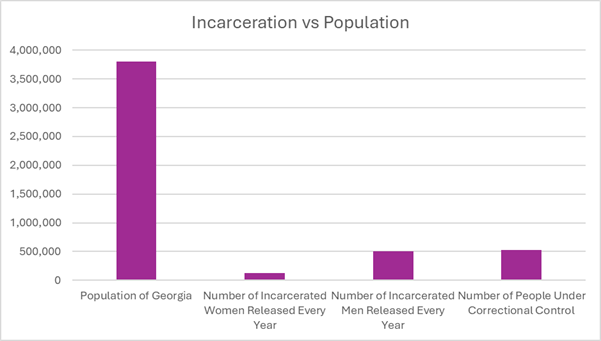
(These statistics are taken from Prison Policy Initiative (n.d.), the Southern Center for Human Rights (2024), and Worldometer (n.d.).)
One wonders why these statistics are so important and what they have to do with impacting our communities. For one thing, not helping the newly released integrate successfully back into society impacts our communities negatively. Many of these men and women feel like they have no options and return to a life of crime. Georgia’s recidivism rate currently sits at 26% (Criminon, 2024). That means 1 in 4 people released from prison will return to incarceration at some point. If the number of people released in a year is around 600,000 then that means approximately 150,000 will be returning to prison. That is even more disturbing when one considers that this is more than likely to happen within the first 3 years of freedom.
One thing many of them face is mental turmoil. It is hard to achieve anything without a sound mind. Around 16 percent of the prison population and 10% of the jail population have identified dealing with serious mental disorders (Health Forward, 2015). Please bear in mind that this is a reported number. The average inmate has an aversion to dealing with staff members and so the actual numbers may be even higher. Couple this with substance abuse issues that many suffer from that either surface before or during incarceration and one sees the beginnings of a perfect storm for failure. Because of the circumstances of their incarceration, they are not suffering alone, their families suffer alongside them. When these men and women are released, if their situations do not change, their families continue to suffer with them, and so do their communities.
It is time for an out of the box solution to the problem of keeping men and women out of a box, so they may help prop up our communities. Earlier we identified that every person has a story and that story affects everyone around them. What is being proposed is a method of teaching returning citizens to recognize their stories, take control of their narrative, and use the tools they are being given as a way of increasing their options and increasing their odds for success. This means our communities are safer and our overall well-being is improved. What is being proposed is Returning Storytellers.
What Is Returning Storytellers
The Returning Storytellers Program is a groundbreaking initiative designed to empower returning citizens—individuals recently released from incarceration—by teaching them the art of storytelling. This innovative approach not only fosters self-expression but also equips participants with essential communication skills, enabling them to reintegrate into society successfully. By addressing the mental, emotional, and practical challenges faced by this demographic, the program aims to reduce recidivism, strengthen families, and build safer, more supportive communities.
Target Demographic
Returning Storytellers focuses on twenty adult men and women released from incarceration within the past five years. Priority is given to those in Georgia, particularly within underserved communities lacking robust reentry resources. Many participants will have experienced challenges related to mental health, substance abuse, or social stigma and are seeking structured, supportive opportunities for personal and professional growth.
Program Goals
The program is designed to address the multifaceted challenges faced by returning citizens through a structured curriculum and supportive community engagement.
- Empower participants to use storytelling as a tool for self-expression, healing, and personal growth.
- Enhance communication skills to improve participants’ relationships and employability.
- Provide a supportive environment that fosters connection, mental wellness, and community reintegration.
- Equip participants with practical tools to navigate challenges such as employment, housing, and societal stigma.
SMART Objectives
- By the end of the program cycle, 75% of participants will complete the storytelling curriculum and demonstrate proficiency in crafting and presenting personal narratives.
- 60% of participants will report improved communication skills as measured through pre- and post-program surveys, aiding in job applications, interviews, and family interactions.
- Host at least two public storytelling events per program cycle where 50% of participants share their stories, boosting confidence and tracking progress.
- Achieve a recidivism rate below 10% among program participants within one year of completion.
Implementation Plan
The program will employ a phased approach to ensure its objectives are met efficiently and effectively.
- Curriculum Development:
A comprehensive curriculum will be created to teach storytelling techniques, journaling, public speaking, and mindfulness practices. The curriculum will integrate evidence-based methods proven to reduce recidivism and promote mental wellness. - Workshops and Mentorship:
Professional writers, storytellers, and educators will lead workshops, teaching participants how to craft compelling narratives and use storytelling to process emotions and communicate effectively. - Community Partnerships:
Collaboration with local organizations such as the Greater Gwinnett Reentry Alliance and the Department of Community Supervision will help identify participants and provide additional resources. - Participant Engagement:
Participants, known as “Storytellers,” will engage in group sessions, individual coaching, and peer support activities to build skills and foster connection. - Showcase Events:
Open mic nights, storytelling showcases, and podcast recordings will provide participants with opportunities to share their stories publicly, build confidence, and demonstrate growth.
Evaluation and Metrics
To ensure the program’s success and accountability, a rigorous evaluation process will be implemented:
- Pre- and Post-Program Surveys:
Surveys will measure participants’ confidence, communication skills, and mental wellness before and after completing the program. - Storytelling Performance:
Participants’ progress will be assessed through the quality and delivery of their narratives during showcase events. - Recidivism Tracking:
Recidivism rates among program alumni will be monitored for three years to evaluate long-term effectiveness. - Qualitative Feedback:
Testimonials from participants, mentors, and community members will provide insights into the program’s impact and areas for improvement.
Budget and Sustainability
The initial funding request for the Returning Storytellers Program is $35,000, allocated toward curriculum development, workshop facilitation, venue rental, and administrative costs. Sustainability efforts include:
- Fundraising and Sponsorships:
Hosting public storytelling events and seeking sponsorships from local businesses and organizations. - Community Partnerships:
Leveraging partnerships to share resources and expand program reach. - Social Media Engagement:
Promoting the program and its success stories to attract additional funding and community support. - Alumni Network:
Engaging program alumni as mentors and ambassadors to support current participants and showcase program outcomes.
Anticipated Outcomes
The Returning Storytellers Program aims to create measurable, positive change for returning citizens and their communities. Key outcomes include:
- Increased self-confidence and communication skills among participants.
- Reduced recidivism rates, contributing to safer communities.
- Stronger family connections and support networks.
- Greater public awareness of the challenges faced by returning citizens and the value of storytelling as a tool for empowerment.
Program Leadership
Adrian English, the program’s founder, is uniquely qualified to lead the initiative. A professional writer and Eagle Scout with a 3.9 GPA at Grand Canyon University, Adrian has firsthand experience as a returning citizen. His personal journey of successful reintegration, coupled with his expertise in storytelling and community service, positions him as a passionate and effective advocate for program participants.
Conclusion
The Returning Storytellers Program offers a transformative approach to addressing the challenges faced by returning citizens. By empowering participants to take control of their narratives, the program reduces recidivism, strengthens families, and enhances community well-being. With your support, we can help returning citizens build brighter futures and create a safer, more compassionate society for all.
Project Evaluation
Returning Storytellers understands the significance of the funding it is seeking. Just as Returning Storytellers seeks to empower its participants and establish a measuring stick of success, the program realizes that the funders will also seek some way to gauge the program’s viability. To foster that understanding, Returning Storytellers has created an evaluation plan which will gauge our established benchmarks and share the results of these evaluations with any interested parties. The following are the criteria which will be used to establish our evaluations and what those evaluations will entail.
Program Goal
The goal of Returning Storytellers is to enrich the lives of returning citizens and give them the tools to better their lives and increase the odds of their post-incarceration success by teaching them storytelling skills, communication skills, and self-expression skills that will aid their transition back into society. For each cycle, twenty returning citizens will be selected to participate in the program.
Objectives
To achieve the program’s goals, Returning Storytellers has established three objectives with benchmarks that highlight the program’s curriculum and how well the program’s twenty participants have engaged with it. The evaluation criteria will be based on the benchmarks within the objectives as well as the objectives themselves. They are as follows:
- By the end of the twelve-month program, 75% of the participants (15) will have learned or improved storytelling and communication skills. At 3 months, they will show they can create basic narratives. At 6 months, they will implement complex elements like character development and emotional narratives. At 9 months, they will show they can create stories with confidence.
- Within six months, 60% of the program’s participants (12) will display increased self-confidence and communication skills. In the 2nd month of the program, they will complete a self-assessment which identifies areas of communication they have problems with. They will form small groups and learn how to give and accept feedback. Then in month 6th, they will deliver a short story based on personal experiences to their peer group.
- By the end of the program, half of the participants (10) will share their stories at an Open House which will help reduce the stigma of returning citizens and create and enhance community connections. In the 6th month of the program, the participants will work on their stories’ final drafts and get detailed feedback from their mentors. In the 9th month, they will begin spoken storytelling rehearsals to refine their spoken narrative styles, and then in the final month of the program, they will present their finalized work to the public and be critiqued by the audience and a guest panel of writers.
Evaluation Methods
To measure the program’s progress and movement towards our established benchmarks, Returning Storytellers will utilize these methods.
- Assessments: There will be three levels of skills assessments at the beginning, middle, and end of the program based on a rubric crafted by the program’s mentors. The rubric can change based on the results of each assessment.
- Journals and Surveys: Participants will be tasked with journals, journaling assignments, surveys, and moments of self-reflection which will document their growth in confidence, mindfulness, and emotional intelligence.
- Staff Feedback: The staff will monitor progress as well and keep track of their observations using forms created for each benchmark.
- Metrics: The Program will keep track of community involvement based on audience surveys, attendance numbers, and participants thoughts on their performance during Open Mike Nights and Open Houses.
Evaluation Questions
The evaluation questions will help gauge the program’s impact as well as its progress. The three main questions used to evaluate the program are as follows:
- Are participants meeting the established learning benchmarks at each stage?
- How has the program impacted the ability of participants to tell stories as well as their self-confidence level over time?
- What improvements are evident in participants’ communication and efforts to reintegrate into society?
Data Collection and Reports
The results of each assessment and survey will be collected, compiled, and analyzed and used to evaluate benchmark progress and program achievement. Quarterly reports will be created that will provide updates on milestones and benchmarks. There will also be an annual report which will track overall performance as well as determine what areas of the program either need to be strengthened or retooled for the next cycle. The goal of these reports is to ensure accountability, participant growth, and demonstrate the value of the program to stakeholders.
It is the hopes of this fledgling program that clears up any issues that may arise about the viability of Returning Storytellers to meet any established metrics and thus prove that it is a satisfactory cause worth supporting. Thank you for your time.
| Projected Budget for Returning Storytellers 2025 | ||||||||
| Personnel Costs | ||||||||
| Item | Cost Per Unit | Quantity | Total | |||||
| Volunteer Appreciation | $25.00 | 10 | $250.00 | |||||
| Personnel Subtotal | $250.00 | |||||||
| Participant Costs | ||||||||
| Item | Cost Per Unit | Quantity | Total | |||||
| Participant Stipend* | $25.00 | 480 | $12,000.00 | |||||
| Transportation Stipend* | $10 | 480 | $4,800.00 | |||||
| Materials (workbooks, journals) | $20.00 | 20 | $400.00 | |||||
| Participant Subtotal | $17,200.00 | |||||||
| Program Supplies and Equipment | ||||||||
| Item | Cost Per Unit | Quantity | Total | |||||
| Workshop Supplies | $50 | 24 | $1,200 | |||||
| Audio-visual equipment rental | $500 | 3 | $1,500 | |||||
| Printing Costs for materials | $200 | 24 | $4,800 | |||||
| Supplies Subtotal | $7,500 | |||||||
| Administrative/Overhead Costs | ||||||||
| Item | Cost Per Unit | Quantity | Total | |||||
| General Use Office Supplies | $100 | 12 | $1,200 | |||||
| Program Evaluation Consultant | $100 | 20 | $2,000 | |||||
| Indirect Costs (utilities/rent) | 10% of total budget | 3,427 | ||||||
| Administrative Subtotal | $6,627 | |||||||
| Event Costs | ||||||||
| Item | Cost Per Unit | Quantity | Total | |||||
| Venue Rental | $1,000 | 1 | $1,000 | |||||
| Catering/Refreshments | $15 | 100 | $1,500 | |||||
| Marketing and Promotion | $500 | 1 | $500 | |||||
| Event Subtotal | $3,000 | |||||||
| Personnel Costs | $250 | |||||||
| Participant Costs | $17,200 | |||||||
| Supplies and Equipment | $7,500 | |||||||
| Event Costs | $3,000 | |||||||
| Administrative Overhead Costs | $6,315 | |||||||
| Total | $34,265 | |||||||
Running a program like Returning Storytellers requires a budget that will ensure that the program is run efficiently and set up for sustainability. The following is an explanation of the budget’s line items.
Funding: Funding for Returning Storytellers will come from multiple sources. There will be a GoFundMe account set up for the program that will run during the program’s course. The anticipated stipend from the Georgia Power Foundation will be $25,000. It’s understood that the Foundation does grants recurringly so additional grants can be asked for. The grant can be applied for again during the duration of the program. So, if Returning Storytellers can successfully receive two grants, then $50,000 would be more than enough to ensure the program’s livelihood.
Personnel Costs: All programming staffing needs include the Program Manager, facilitators, and mentors will be met by volunteers which will minimize program costs. A small stipend of $250 will be set aside for appreciation and recognition of the volunteer’s efforts.
Participant Costs: The total amount of funds allocated for participants is to be $17,200. This will be broken into two areas. One is a participant stipend which will cover any overflow from the transportation stipend as well as any outstanding participant contingency costs. This is to be $12,000. The amount of $4,800 will be set aside as a transportation fund to help meet the need of transportation to program events when necessary. The amount it costs to create journals and workbooks for all 20 participants in the program is $400.
Program Supplies and Equipment: The total supply and equipment budget is $7,500. This includes a $1,200 workshop supply budget for any materials that may be needed for a session such as paper, pens, markers, etc. There is also an audio/visual equipment allotment of $1,500 which will be used to provide equipment for the end of program Open House/Storytelling Event as well as two rehearsal sessions. Lastly, $4,800 will be diverted into printing costs for program materials, handouts, and any materials needed for the Open House event. Community outreach materials will also be created from this fund.
Event Costs: The program culminates with an event in which the participants will showcase their written and spoken narratives and improved communication skills to the community. Total costs for funding this event are $3,000. This money will be broken into three areas. The first is venue rental which will be around $1,000. The venue will hold approximately 100 people. The second area is catering and refreshments for the event, which will cost $1,500. A local restaurant will be hired to cater for the event and the cost averages $15 per person. Marketing and promotion of the event will cost about $500. Materials will be created through a digital printer and a large portion of marketing will be through social media to allay costs.
Administrative and Overhead Costs: The cost of administrative and overhead tasks will be $6,627. The areas into which this money will be allotted are $1,200 for office supplies to be utilized by program staff outside of normal program sessions. Then $2,000 will be used to hire an outside consultant to evaluate the program’s operations. The fee breaks down into $100 per hour. The last section of funds utilized are indirect costs which break down to $3,327 which is ten percent of the overall budget. This will cover utilities, account payments, and any other organizational costs incurred during the programming cycle.
It should be noted that these are expected costs. The number figures are not static, but each expenditure is essential to achieving the program’s objectives, ensuring accountability, and delivering measurable outcomes for funders and stakeholders. In the end, that is what Returning Storytellers wants.
Sustainability Statement
Returning Storytellers is designed with a long-term focus by leveraging strategic partnerships, volunteer engagement, and diversified funding streams to ensure continued impact beyond the initial grant period.
Community Partnerships
We will build partnerships with local organizations, businesses, and community centers to provide in-kind support, including venue spaces, materials, and event sponsorships. These collaborations will reduce operational costs and deepen the program’s community integration, ensuring it remains a valued resource.
Volunteer-Driven Model
The program relies on a dedicated and yet small team of trained volunteers for staffing roles, including facilitators, mentors, and administrators. The volunteer-driven approach minimizes personnel costs while fostering a strong sense of community ownership and engagement.
Participant Contributions and Alumni Involvement
As participants transition to alumni, they will be encouraged to return as mentors or facilitators, reinforcing a cycle of giving back. Alumni involvement ensures the program benefits from lived experience while reducing reliance on external resources.
Diversified Funding
To sustain the program, we will pursue a combination of funding sources, including individual donations, corporate sponsorships, and crowdfunding campaigns. Additionally, we will explore revenue-generating opportunities such as offering storytelling workshops to the broader community on a sliding fee scale.
Program Evaluation and Continuous Improvement
A robust evaluation plan will demonstrate the program’s effectiveness in achieving its goals, providing data to secure future funding and support. Regular assessments will help refine program delivery and ensure it meets evolving community needs.
Through these strategies, Returning Storytellers will remain a vital, enduring initiative, transforming lives and strengthening communities for years to come.
Conclusion
The Returning Storytellers Program represents a powerful, innovative approach to breaking the cycle of recidivism and empowering returning citizens to take control of their narratives. By teaching participants to process their experiences through storytelling, we provide them with the tools to improve communication, build self-confidence, and establish meaningful connections with their families and communities.
This program is not just about personal transformation; it’s about creating safer, more inclusive communities where individuals can thrive and contribute positively. With your support, we can address the challenges faced by returning citizens, reduce recidivism rates, and foster long-term societal benefits.
Your investment in the Returning Storytellers Program is an investment in building communities, restoring lives, and the perseverance of those in unfortunate circumstances. Together, we can ensure that every story told through this program becomes a testament to the power of second chances and the strength of community. Thank you for your consideration.
Respectfully submitted,
Adrian English,
Founder, Returning Storytellers
Appendices
Appendix A: References of Cited Works
Criminon. (2024). Georgia. https://www.criminon.org/where-we-work/united-states/georgia/
Greater Gwinnett Reentry Alliance (2023). https://gwinnettreentry.org
Healthforward (n.d). Re-Entry stats. https://healthforward.org/wp-content/uploads/2015/07/stats-reentry-combined.pdf
Prison Policy Initiative. (n.d.). Georgia profile. Prison Policy Initiative.org. https://prisonpolicy.org/profiles/GA.html
Russ, E., Puglisi, L., Eber, G., Morse, D., Taxman, F., Dupuis, M., Ashkin, E., and Ferguson, W., (2021, Oct 8). Prison and jail reentry and health. Health Policy Brief: Culture of Health. https://healthaffairs.org/content/briefs/prison-and-jail-reentry-and-health
Southern Center for Human Rights. (2024). Mass incarceration. https://www.schr.org/mass-incarceration/#:~:text=While%20the%20national%20data%20is,second%2Dhighest%20correctional%20control%20rate.
Worldometer (2024). Georgia population stats. https://www.worldometers.info/world-population/georgia-population/
Appendix B: Expected Volunteer Commitment
The expected time commitment for volunteers will depend on their role within the program. Here’s a breakdown of the anticipated weekly hours for each volunteer role:
Volunteer Roles and Time Commitment
- Program Manager
- Time Commitment: 5–7 hours per week
- Responsibilities: Oversee program operations, coordinate workshops, manage logistics, and liaise with participants and other volunteers.
- Workshop Facilitators
- Time Commitment: 4 hours per week (per facilitator)
- Responsibilities: Conduct weekly workshops, facilitate discussions, and guide participants through storytelling exercises.
- Mentors/Coaches
- Time Commitment: 2–3 hours per week (per mentor)
- Responsibilities: Provide one-on-one support to participants, review narratives, and offer feedback on progress.
- Administrative Volunteer
- Time Commitment: 2–3 hours per week
- Responsibilities: Handle program documentation, attendance tracking, and assist with reporting and communication tasks.
Summary
On average, each volunteer is expected to contribute 2–7 hours per week, depending on their role. The total commitment is designed to be flexible, ensuring volunteers can balance their contributions with other obligations while still providing meaningful support to the program.
Would you like to adjust these estimates based on specific program needs?
 Adrian English, Words With Purpose